

I had the opportunity to give a talk on forms at the EBI, part of the European Molecular Biology Laboratory (EMBL). “EBI provides freely available data from life science experiments, performs basic research in computational biology and offers an extensiveContinue reading… Designing forms for technical specialists
Category: User research
Search is now normal behaviour – what do we do about that?

What information do visitors search for? What are “good” search results? What are the differences between internal search and external? How do users interact with the Google results page? And what does all of this mean for website design? ReportingContinue reading… Search is now normal behaviour – what do we do about that?
Using measurements to develop complex websites
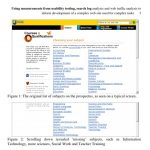
If you are developing a complex website whose users will come to it to carry out complex tasks then you’re likely to want to use a range of data to support your decision-making. This was the situation when I wasContinue reading… Using measurements to develop complex websites
Why we need a ‘qualification brain’: enabling users to navigate a complex curriculum
Why we need a ‘qualification brain’: from product catalogue to dominant narrative – enabling web-enquirers to understand and navigate through a flexible but complex curriculum This paper for the 23rd ICDE World Conference on Open Learning and Distance Education, Maastricht,Continue reading… Why we need a ‘qualification brain’: enabling users to navigate a complex curriculum
Lessons from Celebrity Chefs: heuristic inspection or user-centred design?

Two TV cookery programmes take a contrasting approach to redesigning their menus, with lessons for the way we approach usability in our services.
Culture part 2 – what really matters in designing for different cultures

Caroline Jarrett shares some of her learnings from attending a conference where most participants were working cross-culturally
Design to read workshop – call for participation

Designing for people who do not read easily will actually improve usability for everyone, argues Caroline Jarrett
Colours and Culture – don’t always believe what you read

Thinking about colour in the context of different cultures can be more complicated than we’re led to believe. Caroline Jarrett points out some of the pitfalls.
Designing for search: making information easy to find

Today, search is not a design failure, but part of the user experience, one of many ways that people find information on the web. This paper – co-authored with Whitney Quesenbery, Ian Roddis, Sarah Allen and Viki Stirling – looksContinue reading… Designing for search: making information easy to find
What’s in it for me? Rewarding course evaluators

Everyone likes to be rewarded for their efforts. Course evaluators are no exception. We get asked often to look at new online courses and sometimes even get offered a login name and password to a course that other people wouldContinue reading… What’s in it for me? Rewarding course evaluators