
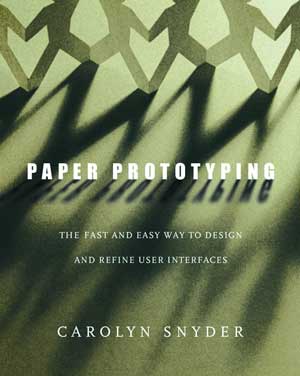
 Way back in 2003, just after Carolyn Snyder published her book on Paper Prototyping, I wrote a 5-star review of it on Amazon, starting: “This is the professional’s dream of a book: easy to read, accurate, full of good ideas.”
More than 20 years later, I picked up my copy again to decide whether to recommend it to someone new to user research. I still fully agree with my original review, and it’s still highly relevant today.
Paper prototyping has not changed very much
Although other technologies have come and gone since 2003, paper is much the same. Throwing some sketches onto paper is still really fast (even though we now have AI and vibe coding). You do not need any artistic ability, and you could even draw with ketchup and make something useful, as I mentioned in how to prototype a digital form on paper.
I’ll be honest and say that the visual design of the book is a touch archaic. If you’re going to be put off by some fonts that few of us have seen for a couple of decades and the occasional screenshot of a computer system that’s long since retired, then this book may not be for you.
It’s also true that colour printing was expensive many years ago, and the publisher chose to go entirely with greyscale images on paper that’s not the best. That might also be a deal-breaker for you.
But paper is still paper, people are still people, and I found that the ideas and recommendations struck me as just as useful today as they did all these years ago. I’m going to pick out a couple of my favourites.
A usability test facilitator has three roles
One area of the book that I found really compelling is her description of the three roles of the facilitator in a usability test.
1. You must be a “flight attendant”
When you are running the test, you need to look after your participant.
Carolyn Snyder calls this being a “flight attendant”, and you need to
- Welcome the participant
- Check that the participant is feeling comfortable and relaxed
- Explain what the participant has to do
- Look after the participant’s welfare and safety.
2. You must be a “scientist”
When you are running the test, you need to be objective. She calls this being a “scientist”:
- Be prepared for surprises
- Be balanced in your viewpoint
- Make sure you do everything you planned to do
- Report accurately, even if it’s uncomfortable.
3. You must be a “sports commentator”
When you are running the test, you need to think about what is happening and share that with observers.
She calls this being a “sports commentator”:
- Analyse what is happening
- Take notes for your reports
- Pay attention to what the participant actually does (and distinguish between observations, inferences, and ideas)
- Make sure your observers are receiving the right information.
Task design for usability testing is still really important
Mostly I’m testing forms, and the task for my usability testing is: “Please have a go at filling in this form”.
But that does leave some details unanswered, such as: Will this participant have the answers easily available? If I supply some answers, does that replicate real life? Do I expect the participants to bring documents with their own real answers to the test, and if so how do I persuade them to bring the documents along?
If you’re testing something else, such as an app or a government service, then you’ll probably have even more details to think about such as where the task might start, what the end point is, and how it fits into other things that the participant might want to do.
It’s well worth reading Carolyn Snyder’s chapter on Task Design for whatever you are testing, as going through her step-by-step process will help you to clarify the difference between task instructions and goals, and their relationship to your research questions.
Real-life experience shines through
Even in the early 2000s, Carolyn Snyder had over a decade of experience of running user research sessions in general, usability testing, and working with paper prototypes. The book is full of practical tips such as collecting smaller pieces of the paper prototype in a “gallery of annoying pieces”, and the value of running a pilot test. She also shares many “tales from the field” from other practitioners, such as evolving a hand-held controller from wooden blocks with stickers through to a full-formed industrial prototype.
For example:
[Disruptive observer behavior] can indeed be a problem but it’s a solvable one. Observers can be trusted to behave appropriately, especially when they are taught about the effects of their behavior on users. After all, we’re talking about fully functioning adults members of society here, not a troupe of baboons”
Carolyn Snyder, Paper Prototyping
If you’re running usability tests, buy this book
By now it will be obvious that I still think this book is essential reading for anyone who is doing paper prototyping. Even if you’re not doing paper prototyping now, get it anyway and maybe it will convince you.
Even if you reject the idea of paper prototyping altogether, get the book anyway. You’ll find lots of value in it for running any sort of usability test.