 When we are faced with the challenge of incorporating AI into our designs, what is the effect of pouring untruthful data into the AI?
During a series of workshops on data quality in 2025, I discovered that nearly all of us admit to an occasional “fudge” (an answer that might not be entirely truthful) on a form or survey.
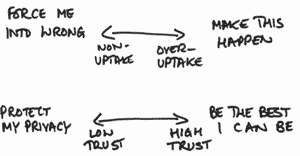
Based on that, I came up with a set of four possible reasons why people lie in their answers:
- the question offers wrong answer options only. Example: it asks about a behaviour but the only options are ‘yes’ or ‘no’ with nothing for ‘sometimes’.
- there’s a need to make something happen. Example: the question asks us to confirm that we have read the terms and conditions.
- they want to protect privacy. Example: the question asks for an email address and we’re worried about being spammed.
- trying to be the best we can be. Example: when applying for a job, there’s social pressure to explain away, or omit, information that might seem negative.
Thank you to UX Scotland 2026 for the opportunity to explore these four possibilities in a workshop.
We spent about half the time thinking about our own experiences and those of the people using our products and services, and about half looking at what to do about that.
My thanks to all those who attended my workshop – your comments and thoughts were great, much appreciated.
Thanks, too, to the event organisers for putting together such an interesting programme of talks and workshops. It’s always a pleasure to visit Edinburgh.