
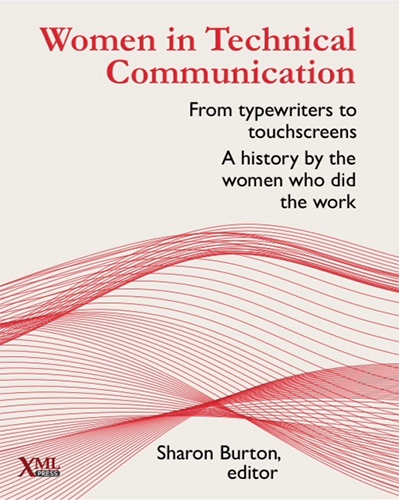
 A few years ago Sharon Burton put out a call to women who had worked in technical communication to tell their stories. The collection, Women in Technical Communication: from typewriters to touchscreens; a history by the women who did the work, was published in 2026.
The stories tell a powerful history of women’s work and women’s lives
The essays not only chart the huge changes that women in technical communication have experienced over the last three decades, they also reflect the ways in which women’s lived experience has changed – and in some cases remains unchanged.
The sexism encountered by Brenda Huettner, the only female manager sitting at the table in the database company she joined, expected by all her colleagues to take the minutes, is only one of many stories reflecting the reality of many of the authors’ early careers.
Other accounts, such as Caroline Jarrett’s description of being forced into a kind of accidental retirement by the need to care for elderly parents, shows how much still needs to change.
As I browsed the pages I decided contributor Yvonne Wade Sanchez might compare notes with Suzanne Rubinstein.
Both have suffered from a lifetime of ‘but what IS technical communication’ questions.
Wade Sanchez’s diatribe about working in an industry whose job title changes every few years (her current title is DAM Strategist but she lists at least seven different versions that came before) concludes with her admitting: “I hate that I need to string so many words together into a long-ass (non-concise) sentence to describe what we do as if we’re the Swiss Army life of professions.”
Earlier Suzanne Rubinstein, a bilingual technical writer based in Mexico, brilliantly tells us why the technical communication profession – whatever it’s called – matters.
Technical writing, she insists, is “storytelling for people in a hurry. It’s clarity under pressure. It’s the calm voice in the chaos.”
Few of the authors set out to work in technical communication
Time and again the women in this book describe how they ‘fell into’ a profession they didn’t even know existed. Starting out as secretaries, teachers, engineers, they became groundbreakers – part of the first generation to expect professional careers to support themselves or their families.
Many of those who appear in the book, like Ginny Redish, became leaders in their field. Others pioneered a career path for the women who came after them in their countries and cultures.
For almost all there was the joy of finding among their peers a community of female inspiration, mentoring and support.
In her foreword Sharon Burton explains her decision to let “the voices of the women tell their story how they think is the right way to tell their story…each one gets to define the things that mattered to her when she wrote the piece.”
That is one of this fascinating book’s great strengths, that each of the stories is deeply personal, reflecting the richness of lives spent breaking new ground, challenging ignorance and glass ceilings, and finding huge fulfillment in careers dedicated to making the complex accessible for the rest of us.
A note from Caroline: I asked Jane to review this book. I was honoured to contribute my own essay and loved reading the other ones in the book, and I thought you might enjoy reading a view of it from someone who has worked alongside me but isn’t a technical communicator.